

cultural barriers
** THIS PAGE IS UNDER CONSTRUCTION – MORE COMING SOON! **
We all want diversity in our organizations, but the truth is – diversity in teams is a double-edged sword. Without intentional approaches to ensure an inclusive environment, more often than not, diversity exacerbates misunderstandings and leads to faulty attributions. Diverse teams must first overcome the challenges of diversity, before they can reap the many benefits that diversity in a team offers.
Let’s talk about culture, for example – “an accumulated pattern of values, beliefs, and behaviors shared by a group of people with a common history and verbal and non-verbal system” [Neuliep, 200].
Imagine an employee who seems to lack initiative. They constantly wait for detailed instructions. After a year, their progress is slow. They seem visibly frustrated but do not seek or ask for help. Is this a “bad” employee ? Or are these examples of deep-seated differences in cultural values? For example, individuals from relatively more hierarchical cultures (e.g. India, China, Iran) are likely to treat their supervisors with high deference. This may manifest as expecting detailed instructions on project direction, while reading implicit cues from non-verbal and environmental context [Laroche, 2001]. From the lens of Canadian culture, these behaviors may be falsely attributed as lacking assertiveness or creativity, which then may impact employer decisions on how to hire, fire, or promote. Recruiting a culturally diverse team thus requires an extensive understanding of how culture impacts communication and conflict. The experiments below aim to explore cultural and language diversity differences in global virtual teams; particularly in the use of Computer-Mediated Communication channels like videoconference or email. This research program aims to explore the design, development, and evaluation of cross-cultural collaboration systems to mitigate cultural barriers in global teams.
Language barriers
Now, let’s talk about language – a seemingly simple dimension of diversity. It is not.
With more than 471,000 permanent immigrants in Canada, language barriers remain an unacknowledged barrier. Given the mandate of English as a common language in most workplaces around the world, native speakers of English receive unearned status gain and huge amounts of privilege. Because command of the common language is power — it affects how you are perceived by your supervisors, colleagues and teammates. When you can’t speak in your native tongue to express yourself or your competence at work, it’s like walking through jelly.
Technologies to Mitigate Intercultural Conflict
[2] Helen Ai He, Naomi Yamashita, Chat Wacharamanotham, Andrea B. Horn, Jenny Schmid, Elaine M. Huang. “Two Sides to Every Story: Mitigating Intercultural Conflict through Automated Feedback and Shared Self-Reflections in Global Virtual Teams”. In Proceedings of the ACM: Human Computer Interaction (PACM 2017), 1(2), pp. 51-72. ACM, 2017.
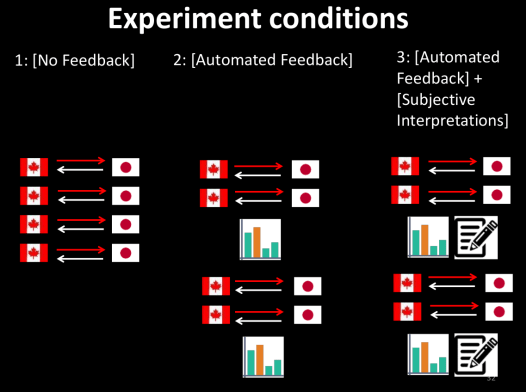
Global virtual teams experience intercultural conflict. Yet, research on how Computer-Mediated Communication (CMC) tools can mitigate such conflict is minimal. We conducted an experiment with 30 Japanese-Canadian dyads who completed a negotiation task over email. Dyads were assigned to one of three conditions: C1) no feedback; C2) automated language feedback of participant emails based on national culture dimensions; and C3) automated language feedback (as in C2), and participants’ shared self-reflections of that feedback.
Results show Japanese and Canadian partners interpreted the negotiation task differently, resulting in perceptions of intercultural conflict and negative impressions of their partner. Compared to C1, automated language feedback (C2) and shared self-reflections (C3) made cultural differences more salient, motivating participants to empathize with their partner. Shared self-reflections (C3) served as a meta-channel to communication, providing insight into each partner’s intentions and cultural values. We discuss implications for CMC tools to mitigate perceptions of intercultural conflict. Check out our full paper here!
[3] He, Helen Ai, and Elaine M. Huang. “A qualitative study of workplace intercultural communication tensions in dyadic face-to-face and computer-mediated interactions.” In Proceedings of the 2014 conference on Designing interactive systems, pp. 415-424. ACM, 2014.
We present findings from a qualitative study with 28 participants of the intercultural communication tensions professionals experience in Face-to-Face (FTF) and Computer-Mediated Communication (CMC) workplace interactions. We identify four categories of intercultural communication tensions that emerged most frequently in our dataset including range of emotional expression, level of formality, “fixed” versus flexible appointments and task versus social-orientation.
We discuss how these tensions manifested in FTF and CMC media and unravel the ways media supports or hinders intercultural communication. We present the adaptations participants made to mitigate such tensions and offer implications for design. Our findings demonstrate that the most frequently occurring intercultural communication tensions manifested in both FTF and CMC, regardless of the medium used. This indicates that cultural communication challenges will persist no matter the medium, highlighting the opportunity for technologies to better support workplace intercultural communication.


[4] Helen Ai He, Nemanja Memarovic, Amalia Sabiescu, and Aldo de Moor. “CulTech2015: cultural diversity and technology design.” In Proceedings of the 7th International Conference on Communities and Technologies, pp. 153-156. ACM, 2015.
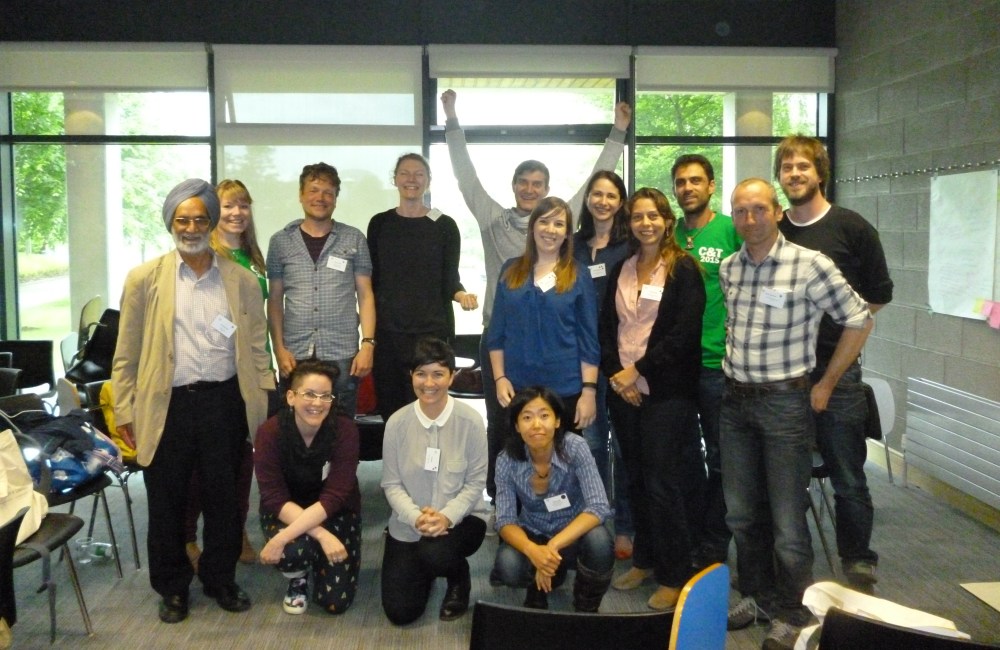
With globalization and technological advances, people are increasingly coming into contact with others from different cultural backgrounds, particularly in place-based and virtual communities. Yet, cultural diversity – the diversity of community members’ cultural backgrounds – offers both significant benefits and challenges in the design, usage and evaluation of technologies. In this one-day workshop, we explore the role of cultural diversity in potentially informing, supporting, challenging or impacting the design of Information and Communications Technology (ICT) within community contexts.
To delve into this complex and multi-faceted space, we welcome workshop submissions that 1) engage broadly with the role of culture within technology design and usage for, with and by communities, as well as 2) proposals for approaches, tools, conceptual and methodological frameworks, case studies and best practices in community-based design that exploit cultural diversity as an asset and seek to encourage intercultural interactions. Our goal is to bring together academics and practitioners from different domains such as computer science, urban design, interactive art, anthropology and social sciences who share a common interest in exploring the design space of ICTs, culture and communities. Check out the workshop abstract and workshop agenda here!


 The Mindful Academic